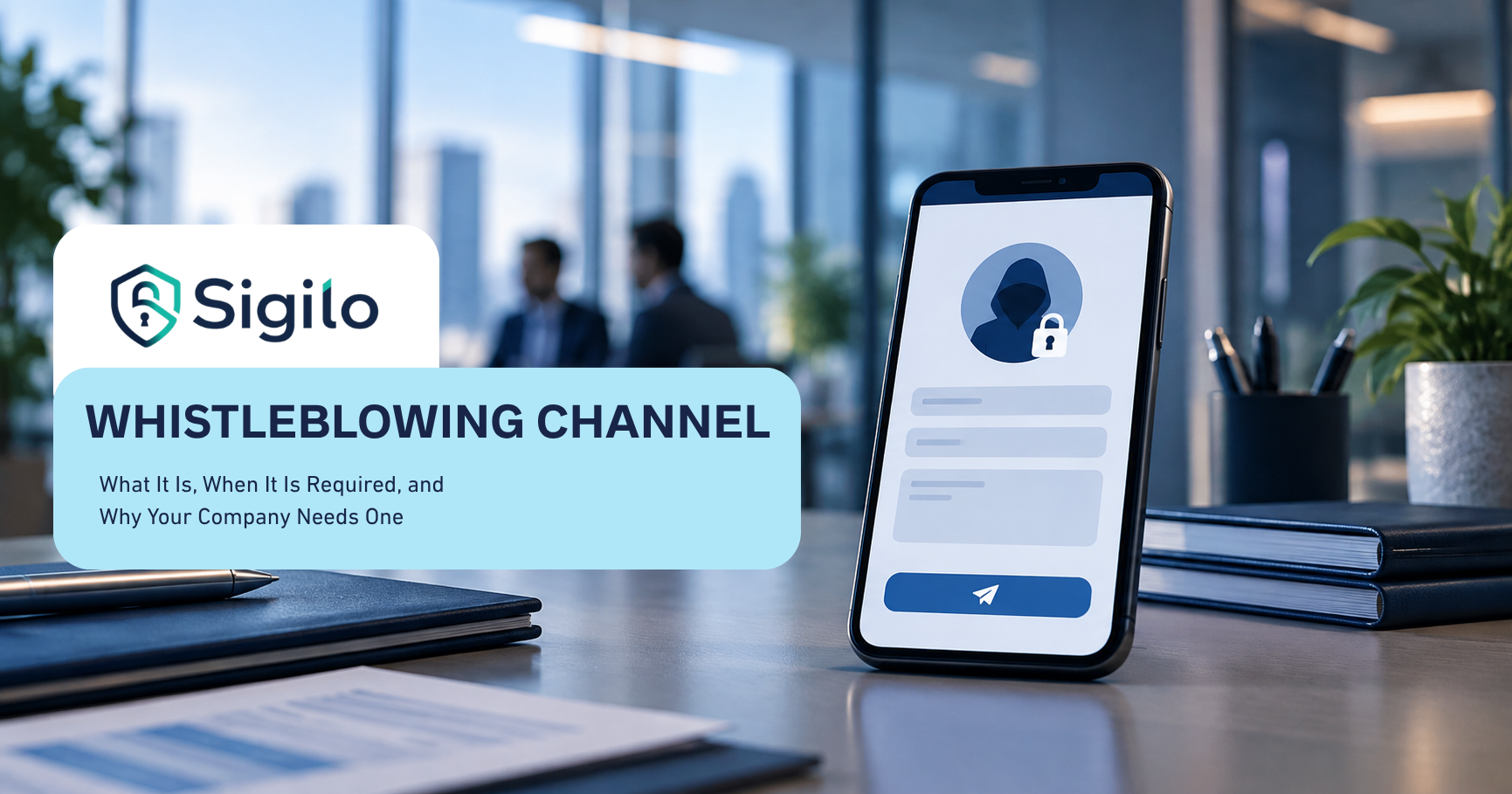
A whistleblowing channel is a formal and secure way for employees and other people connected to a company to report misconduct, such as harassment, fraud, discrimination, corruption, or violations of internal policies.
For certain companies in Brazil, maintaining procedures to receive and follow up on reports is not only a compliance best practice: it is a legal requirement under Brazilian Law No. 14,457/2022.
But complying with the law is only part of the issue.
A whistleblowing channel only works when people trust that they can speak up without facing consequences. And that is exactly where the difference lies between simply providing a form and building a reporting channel people can actually trust.
In this article, you will understand what a whistleblowing channel is, which companies are required to have one in Brazil, how it works, and what to consider before implementing one in your organization.
What is a whistleblowing channel?
A whistleblowing channel is a structure designed to allow employees, suppliers, customers, and other stakeholders to safely report potential misconduct or irregularities.
Common reports may involve:
workplace or sexual harassment;
discrimination;
fraud;
corruption;
conflicts of interest;
misappropriation of company resources;
violations of the code of conduct;
workplace violence;
labor-related misconduct;
violations of internal policies.
A reporting channel may allow identified or anonymous reports. However, when a whistleblower chooses anonymity, simply hiding their name is not enough.
A truly anonymous system should be designed to minimize the possibility of indirectly identifying the person who submitted the report.
This involves factors such as IP address logging, cookies, technical identifiers, session data, access controls, and even metadata contained in uploaded files.
Why does a company need a whistleblowing channel?
There is an uncomfortable reality in virtually every organization: not everything that happens reaches senior management.
The larger the company becomes, the harder it is for leadership to fully understand what is happening across different departments and levels of the organization.
And this is not always the result of bad intentions.
Imagine an employee who is being harassed by their own manager. Who are they supposed to report it to?
Or someone who identifies potential fraud involving a colleague with a close relationship to senior management.
Is it reasonable to expect that person to reveal their identity and accept the risk of retaliation?
Silence does not necessarily mean there is no problem.
Sometimes it simply means that the perceived cost of speaking up is too high for the person who has the information.
A well-designed anonymous reporting channel helps reduce that barrier.
When people have a safe environment in which to report a situation, the company gains access to information that might never reach management through traditional channels.
And that can make a measurable difference.
According to the Occupational Fraud 2026: A Report to the Nations, published by the Association of Certified Fraud Examiners (ACFE), 43% of the fraud cases analyzed were initially detected through tips. More than half of those tips came from employees.
In other words, someone inside the organization often already knows that something is wrong.
The question is whether there is a safe way for that person to speak up.
Is a whistleblowing channel mandatory in Brazil?
For certain companies, yes.
Brazilian Law No. 14,457/2022 introduced measures aimed at preventing and addressing sexual harassment and other forms of workplace violence for companies that have a Comissão Interna de Prevenção de Acidentes e de Assédio - CIPA, Brazil's Internal Commission for Accident and Harassment Prevention.
Among the measures established by the law are procedures for:
receiving and following up on reports;
investigating reported facts;
applying administrative sanctions when appropriate;
preserving the anonymity of the whistleblower.
The law also establishes internal rules of conduct related to harassment and violence, as well as periodic training and employee awareness initiatives.
Companies were given 180 days after Law No. 14,457/22 came into force to adopt these measures. That period ended in March 2023.
Therefore, companies covered by the law are no longer within a transition period.
Are companies with more than 20 employees required to have one?
There is a common misconception around this issue.
There is no general rule stating that every Brazilian company with 20 employees must have a CIPA.
CIPA requirements are determined by Brazilian Regulatory Standard NR-5, which considers factors including the number of employees at the establishment and the level of occupational risk associated with its economic activity.
For certain activities, the requirement to establish a commission may begin around this number of employees. For others, the threshold may be different.
For this reason, companies should assess their specific classification under NR-5 rather than relying solely on their total headcount.
The obligation established by Law No. 14,457/22 is directly connected to companies that are required to maintain a CIPA.
Even when a company is not specifically covered by this obligation, however, maintaining a structured reporting channel can still make sense as a governance, risk prevention, and organizational protection measure.
After all, an employment lawsuit, fraud case, or harassment incident does not disappear simply because a company has fewer employees.
What changed with NR-1?
Since May 26, 2026, the revised wording of section 1.5 of Brazilian Regulatory Standard NR-1 has expressly included work-related psychosocial risk factors within Occupational Risk Management requirements.
This increases companies' responsibility to consider factors related to both the organization of work and workplace relationships.
Situations involving violence, harassment, excessive pressure, conflict, and other conditions capable of affecting workers' health are now part of a broader framework for identifying, assessing, and preventing occupational risks.
A whistleblowing channel does not replace the risk management processes required under NR-1.
It can, however, serve as an important source of information for identifying situations that may be difficult to detect through formal indicators or administrative analyses alone.
The first sign that your reporting channel works may be bad news
Some companies experience an unexpected effect when they implement a whistleblowing channel for the first time: problems begin to surface.
That does not necessarily mean the workplace has become worse.
It may mean exactly the opposite.
Problems that previously existed in silence are finally reaching the organization.
That distinction matters.
The reporting channel does not create the problem. It improves the company's ability to see it.
For that reason, a complete absence of reports should also be assessed carefully.
It may genuinely mean that there are no significant incidents.
But it may also mean employees:
do not know the channel exists;
do not believe it is truly anonymous;
fear retaliation;
do not know how to use it;
do not believe the company will investigate;
believe that reporting will not change anything.
A good whistleblowing channel must work both technically and culturally.
What should a good whistleblowing channel include?
Technology matters, but process design is just as important.
1. Anonymity that is technically credible
Simply placing the words “100% anonymous” on a webpage is not enough.
Companies need to understand what information the platform actually records.
IP addresses, cookies, persistent identifiers, and certain technical information may create ways to associate a report with the person who submitted it.
At Sigilo Profissional, for example, the whistleblower's IP address is not stored, the person does not need to create an account or provide a name or email address, and the protocol used to follow the case is generated independently.
There is another important consideration: uploaded files may contain their own metadata, such as information about the author, device, or location.
That is why technology and guidance for whistleblowers must work together.
2. Conflict-of-interest management
Imagine that every report submitted to a company is sent directly to the HR director.
Now imagine that a report concerns that same director.
The reporting process must be designed for this scenario.
Companies should define responsible parties and alternative routing mechanisms for cases in which someone responsible for reviewing a report is mentioned in the report itself.
At Sigilo, for example, plans that use reporting groups can use automatic exclusion mechanisms to prevent a manager named in a report from receiving access to that case.
3. The ability to follow up on a report
After submitting a report, the whistleblower needs to know that it has not simply disappeared.
A case protocol allows the person to check the status of the report and, depending on the solution being used, communicate with the company without revealing their identity.
This continuity helps build trust and may also allow investigators to request additional information during the investigation.
4. Clearly defined responsibilities
Receiving a report is only the beginning.
The company should determine in advance:
who receives reports;
who performs the initial triage;
who investigates;
how conflicts of interest will be handled;
how decisions will be documented;
who will have access to each type of information.
Without this process, the reporting channel can simply become another inbox filled with problems that have no clearly assigned owner.
5. Case history and audit trail
“Substantiated” or “unsubstantiated” should not be the entire record of a case.
Companies should maintain records of actions taken, analyses performed, and, where applicable, the measures adopted in response.
This audit trail helps the company demonstrate that it received a report, investigated the situation, and followed the appropriate internal procedures.
How much does a whistleblowing channel cost?
For many years, compliance solutions were primarily designed for large corporations.
That often meant long sales processes, assisted implementation, annual contracts, and prices that were difficult for small and medium-sized businesses to afford.
That landscape has changed.
Today, self-service solutions make it possible to implement a professional reporting channel without the same structure traditionally required by enterprise platforms.
At Sigilo Profissional, for example, whistleblowing channel plans currently start at BRL 99.90 per month, with self-service subscription and options that scale according to the number of employees and the management features required.
This makes tools that were once concentrated among large corporations accessible to smaller businesses as well.
How to implement a whistleblowing channel in your company
Implementation does not need to be complicated.
A good starting point is to:
Assess your company's legal requirements, including whether it is required to maintain a CIPA and how the commission should be structured.
Choose a platform that supports genuine anonymous reporting and is transparent about the data it collects.
Define who will be responsible for receiving reports and establish alternatives for potential conflicts of interest.
Configure reporting categories that are relevant to your organization.
Define the investigation and case-management workflow.
Communicate the reporting channel to all employees.
Include the channel in employee onboarding and in periodic training and communication initiatives.
Monitor reporting data and indicators to identify recurring issues and patterns.
QR codes in common areas, intranet links, internal communications, training sessions, and onboarding materials can all help increase awareness of the channel.
Because there is a simple rule:
a reporting channel that nobody knows about is unlikely to be used.
A whistleblowing channel is more than a legal requirement
It is easy to see a whistleblowing channel as just another compliance requirement.
But its value begins where formal compliance ends.
A well-designed channel allows an organization to identify situations that might never reach senior management through any other route.
Fraud may be detected earlier.
Harassment cases may be investigated internally.
Recurring problems within teams may reveal leadership or process failures.
And information that previously circulated only through informal conversations can reach the people who actually have the ability to act.
The question, therefore, is not simply whether your company needs to have a whistleblowing channel.
It is whether, when someone inside the organization notices something wrong, that person will have a safe way to speak up.
Does your company still need a whistleblowing channel?
Sigilo Profissional allows companies to create an anonymous and encrypted whistleblowing channel designed for organizations of different sizes.
Whistleblowers do not need to create an account or provide their name or email address, and their IP address is not stored by the system. Companies receive reports in a dedicated environment with case management, monitoring, and audit features.
Explore Sigilo Profissional's plans and implement a whistleblowing channel for your company.